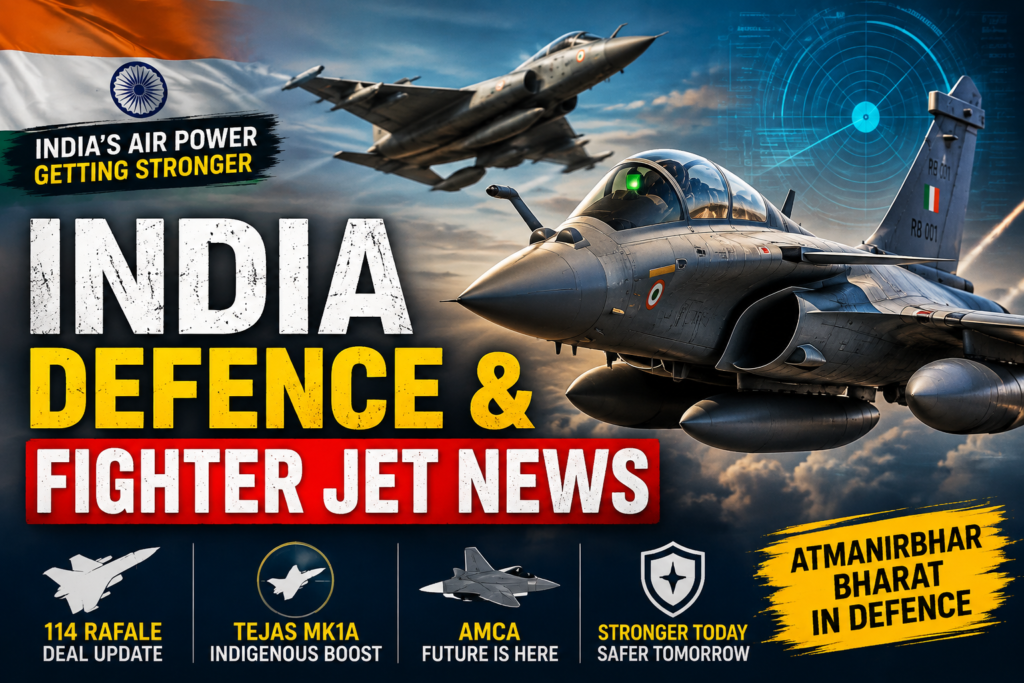
India’s defence aviation sector is going through an important phase, with developments involving Rafale fighter jets, Tejas Mk1A and the Advanced Medium Combat Aircraft (AMCA).
The government is focusing on strengthening the Indian Air Force while also increasing domestic production and defence technology.
114 Rafale Fighter Jets Proposal
One of the biggest recent developments is France’s submission of a formal technical and commercial proposal to India for 114 Rafale fighter jets.
The proposed deal is estimated at around ₹3.25 lakh crore. It also includes plans for local production and technology transfer, supporting India’s wider push for defence manufacturing in the country.
India and Sixth-Generation Fighter Technology
India is also looking at future fighter technology. The government has confirmed that discussions are taking place with France regarding possible participation in the Future Combat Air System (FCAS) programme.
The programme is focused on next-generation air combat capabilities, including advanced aircraft, stealth technology, artificial intelligence and unmanned systems.
Tejas Mk1A Development
The indigenous LCA Tejas Mk1A remains an important part of India’s fighter aircraft strategy.
DRDO has developed an indigenous radome for the Tejas Mk1A. The component has completed important structural, mechanical and electromagnetic evaluations and is moving towards flight trials and industrial production.
This type of domestic technology development can reduce dependence on imported components.
AMCA: India’s Future Stealth Fighter
India is also developing the Advanced Medium Combat Aircraft (AMCA), a proposed fifth-generation fighter aircraft.
The Defence Ministry has moved forward with industry participation in the programme, with shortlisted Indian companies expected to work on prototypes. The project is intended to strengthen India’s long-term indigenous fighter aircraft capabilities.
Why Fighter Jets Are Important for India
Modern fighter aircraft are important for air defence, surveillance, deterrence and combat operations.
India is working on a combination of imported platforms such as Rafale and indigenous aircraft such as Tejas and AMCA. This approach aims to address immediate operational requirements while developing domestic aerospace capabilities for the future.
Focus on Self-Reliance
A major theme in India’s defence strategy is self-reliance. Indigenous aircraft, engines, radars, missiles and other systems can help reduce dependence on foreign suppliers.
Recent developments in Tejas components and the AMCA programme show the growing role of Indian companies and research organisations in defence aviation.
Conclusion
The latest India Defence & Fighter Jet News shows that India’s military aviation sector is moving on several fronts. The proposed 114 Rafale acquisition could strengthen the IAF in the near term, while Tejas and AMCA remain important to India’s long-term goal of building a stronger domestic fighter aircraft industry.
With next-generation technologies also receiving attention, India’s fighter jet programme is expected to remain an important defence topic in the coming years.
Leave a Reply