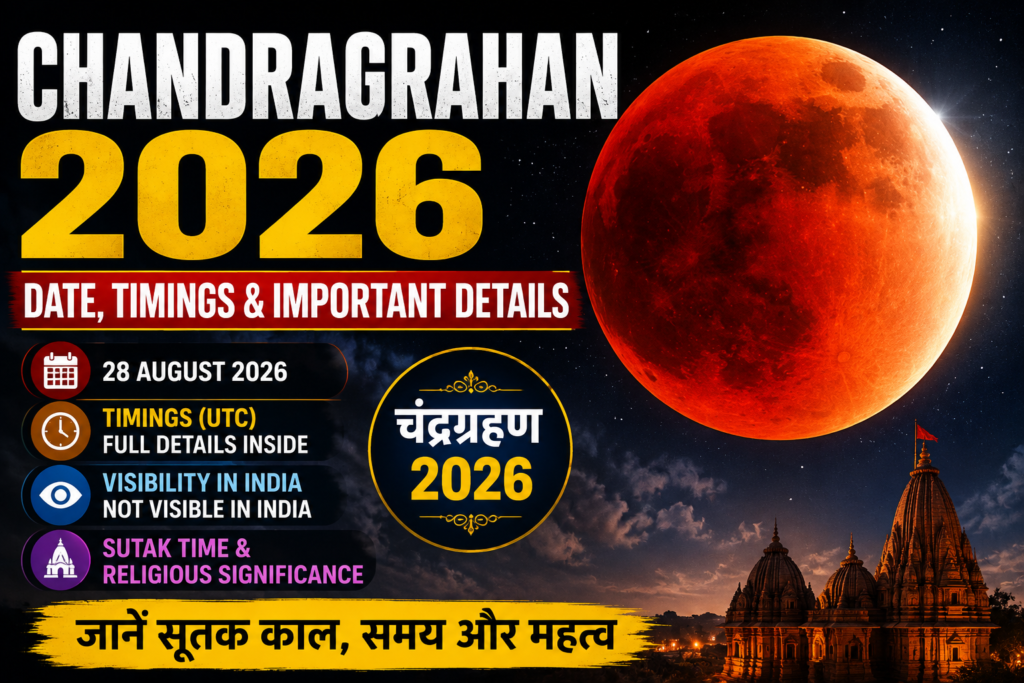
Chandra Grahan 2026 is an important astronomical event that has attracted attention among skywatchers and the general public. A lunar eclipse happens when the Earth comes between the Sun and the Moon, causing the Earth’s shadow to fall on the Moon.
What is Chandra Grahan?
A Chandra Grahan, or lunar eclipse, occurs during a full Moon when the Sun, Earth and Moon align in a way that allows the Earth to block sunlight from reaching the Moon directly.
Depending on the alignment, the Moon can appear darker or take on a reddish colour.
Chandra Grahan 2026
The lunar eclipse in August 2026 is one of the major astronomical events of the year. People are interested in its exact timing, visibility and whether it can be observed from India.
For skywatchers, the best viewing experience depends on the eclipse’s visibility from their location and local weather conditions.
Will Chandra Grahan 2026 Be Visible in India?
The August 2026 lunar eclipse is not expected to be visible from most parts of India. Therefore, people in India may not be able to watch the eclipse directly from their locations.
Visibility can vary depending on the exact phase and geographical location.
Chandra Grahan and Sutak
In Hindu traditions, a period known as Sutak is associated with lunar and solar eclipses. Religious practices and beliefs regarding Sutak vary among families and communities.
It is important to remember that these are cultural and religious traditions, not scientific rules.
Why is a Lunar Eclipse Important?
A lunar eclipse provides an opportunity to observe the movement and alignment of the Earth, Moon and Sun. Unlike a solar eclipse, viewing a lunar eclipse does not normally require special eye protection.
Conclusion
Chandra Grahan 2026 is an interesting astronomical event for both skywatchers and people interested in Indian traditions. Although its visibility from India may be limited, the eclipse remains an important celestial event of 2026.
Note: Eclipse timings and visibility can vary by location. Readers should check reliable astronomical sources for local details.
Leave a Reply